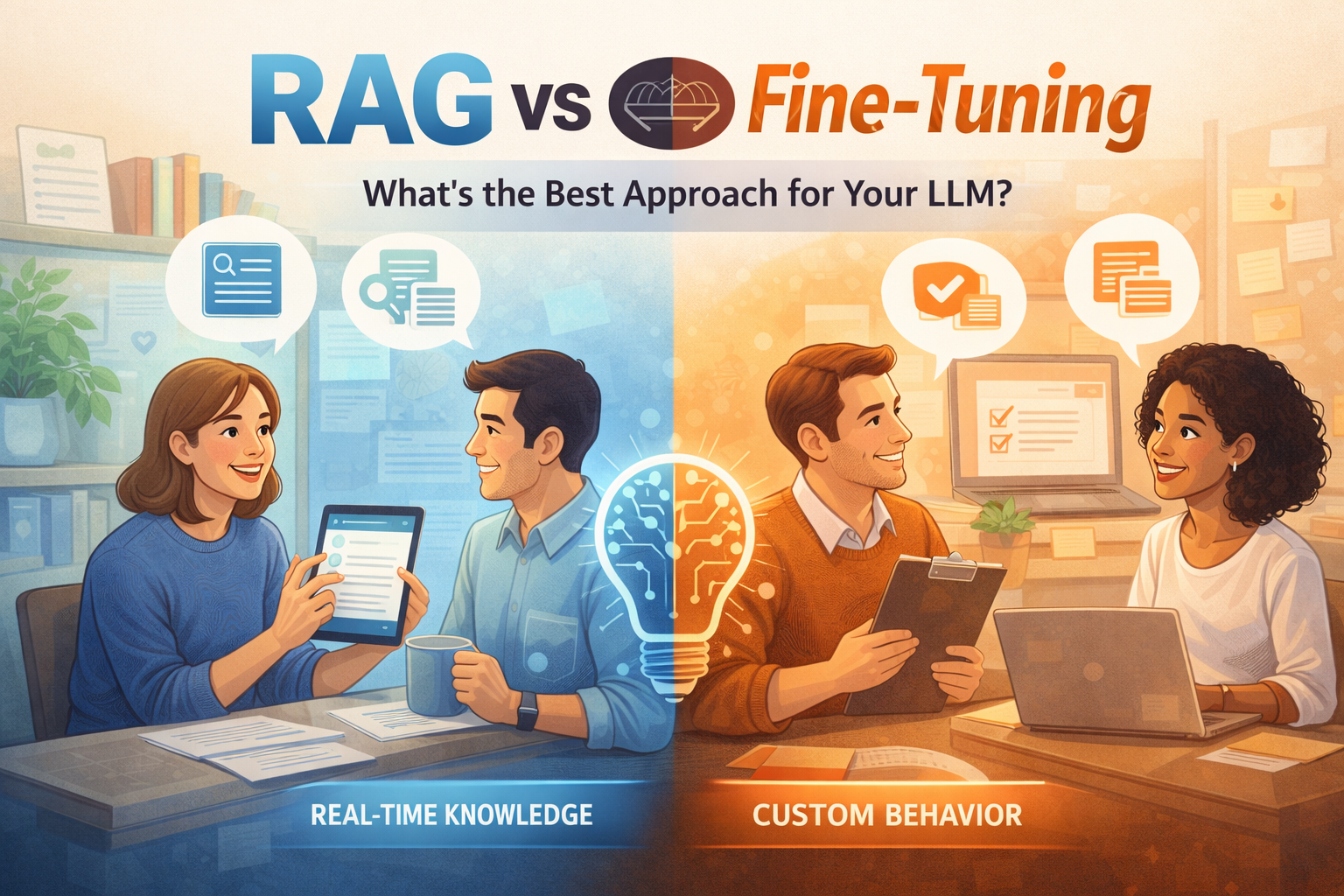
Most teams hit the same wall: your LLM demo works in a sandbox, then fails the moment it meets real company data, changing policies, or domain-specific language. The core question becomes RAG vs fine-tuning, which approach should you use to “tune” your system for production?
In one sentence: RAG (Retrieval-Augmented Generation) makes an LLM answer using external, up-to-date sources at run time, while fine-tuning changes the model’s behavior by training it on examples.
If you want to see how these approaches map to real workflows, explore the MyBrainPack Product → to understand where RAG, fine-tuning, and guardrails fit end-to-end.
What “tuning” really means (and what it doesn’t)
A common misconception is that you must pick one approach forever. In practice, “tuning” usually means choosing the right mix of:
- Knowledge (facts, docs, policies) → usually best handled with retrieval
- Behavior (tone, format, decision rules) → often improved with fine-tuning
- Reliability (grounding, citations, guardrails) → typically a system design problem, not just training
RAG (Retrieval-Augmented Generation) explained
RAG is a system pattern: you index your documents (often in a vector database) and retrieve the most relevant passages for a user’s query, then provide those passages to the LLM as context.
When RAG is the best fit
RAG tends to win when:
- Your knowledge changes frequently (policies, product docs, SOPs—and even pricing)
- You need answers grounded in source-of-truth content
- Compliance matters and you want traceability (for example, “show your sources”)
- You can’t or shouldn’t put sensitive data into training pipelines
Typical RAG failure modes to plan for
RAG can underperform if:
- Retrieval brings the wrong chunks (bad chunking, weak embeddings, messy docs)
- The context window is overloaded (too much text, not enough signal)
- The model “hallucinates” anyway because grounding instructions are weak
- Your search layer isn’t tuned (filters, metadata, recency, permissions)
Fine-tuning explained
Fine-tuning updates a model’s parameters so it behaves differently—commonly to follow a specific style, output structure, or domain patterns more consistently.
When fine-tuning is the best fit
Fine-tuning tends to win when:
- You need consistent formatting (JSON, templates, strict schemas)
- You want a stable writing voice or brand tone
- You have repeated workflows with clear “right answers”
- Prompting alone is too brittle or too expensive (tokens/latency) at scale
Typical fine-tuning risks and costs
Fine-tuning can disappoint if:
- The main problem is missing knowledge (training won’t keep facts current)
- Your training set is small, noisy, or inconsistent
- You don’t have an evaluation loop, so regressions slip into production
- The model “learns” sensitive info you didn’t intend to encode
RAG vs fine-tuning: the decision framework
If you only remember one thing, remember this: RAG is usually for knowledge, fine-tuning is usually for behavior.
Choose RAG if your primary problem is “what to say” Pick RAG when success depends on:
- Accurate facts from internal docs
- Up-to-date information
- Auditable answers (citations, quotes, links to sources)
- Role-based access control and data permissions
Choose fine-tuning if your primary problem is “how to say it”
Fine-tuning wins when you need consistent tone, formatting, or decision rules across high-volume workflows—especially when you’ve already stabilized the knowledge layer.
The hybrid approach most teams end up using
Many production systems use RAG + light fine-tuning (or RAG + strong prompt patterns) because it splits responsibilities cleanly.
A practical hybrid pattern
- Use RAG to fetch the right internal context (policies, contracts, product docs)
- Use fine-tuning (or structured prompting) to enforce:
- output format (schemas)
- tone/brand voice
- decision rules (what to include/exclude)
- Add guardrails: validation, refusal logic, and citations checks
What to measure (so the decision isn’t subjective)
Even without perfect data, you can evaluate “better” with a small, repeatable test set:
- Answer groundedness: does the response rely on retrieved sources?
- Task success rate: did it produce the correct action/output format?
- Latency: time to first token and total response time
- Cost per request: tokens + retrieval + infra overhead
- Failure severity: how bad is it when it fails?
To estimate total cost realistically (model tokens + retrieval + evaluation + ops), review MyBrainPack Pricing and compare what typically drives spend in RAG-heavy vs fine-tuned setups.
Conclusion
Use RAG to keep answers tied to current, verifiable knowledge; use fine-tuning to make outputs consistent and workflow-ready. If you’re unsure, start with RAG (it’s usually faster to iterate), then add fine-tuning only where behavior consistency becomes the bottleneck.
Next steps
If you’re building an internal assistant, support copilot, or knowledge bot, aim for a quick pilot that proves value without locking you into one path:
1. Stand up a minimal RAG pipeline on your highest-value docs.
2. Define 20–50 real questions and score outputs for groundedness and accuracy.
3. Identify the top two failure patterns (retrieval quality vs output consistency).
4. Apply the smallest fix that moves the metric: retrieval tuning first, fine-tuning second.
Frequently asked questions: RAG vs fine-tuning
Can I use RAG and fine-tuning together? Yes. Most production systems use both: RAG to retrieve accurate, current knowledge and fine-tuning (or structured prompting) to enforce consistent tone, format, and behavior.
When should I start with RAG instead of fine-tuning? Start with RAG when your knowledge changes often, when you need citations, or when you can't expose training data to a model provider. Fine-tune only after the knowledge layer is stable.
Does fine-tuning eliminate hallucinations? No. Fine-tuning changes behavior patterns, not factual grounding. If the model didn't learn the right facts during training, it will still hallucinate. RAG is better at grounding answers in verifiable sources.
How long does fine-tuning take vs setting up RAG? A basic RAG pipeline can be operational in days. Fine-tuning requires dataset preparation, training runs, and evaluation cycles — typically weeks to months for production-grade results.
CTA: If you want help choosing the right approach and designing a production-ready architecture, try MyBrainPack → and map your use case to a measurable rollout plan. See Pricing →